Sarà capitato anche a voi leggere e sentire, in questi giorni, frasi del tipo: "
l'uragano Sandy è una palese dimostrazione del cambiamento climatico indotto dalle attività dell'uomo".
Io stesso ho dovuto frequentemente rispondere a domande del tipo: "
questi fenomeni sono sempre più frequenti e violenti, vero?".
E persino una giornalista mi ha chiesto: "
pensi che dovremmo preoccuparci anche noi visto che, come dicono molti, questi uragani saranno sempre più probabili anche dalle nostre parti?"
Ebbene, anche io ho ascoltato, esterrefatto, le affermazioni del Ministro Corrado Clini, durante il TG1 che, quasi fosse un esperto, dava come responsabile assoluto di fenomeni quali quello che ha colpito gli USA orientali, l'uomo e le sue attività.
In realtà non esiste nessuna ricerca al mondo che sia riuscita a dimostrarne una correlazione. Questa è la verità!
Nonostante insistenti tentativi (e giusti, per carità), in tale direzione, abbiano fallito tutti miseramente, è ormai opinione comune che i fenomeni violenti, uragani inclusi, siano aumentati e sia aumentata la loro potenza.
E' falso, e lo dimostrano i risultati delle stesse ricerche di cui sopra.
E infatti lo stesso IPCC nel "
Summary for Policy Makers dello Special Report sugli Eventi estremi dell’IPCC (2011)" scrive:
L’incertezza nelle serie storiche dei cicloni tropicali, l’incompleta comprensione dei meccanismi fisici che collegano i i cicloni tropicali alle metriche del cambiamento climatico e il livello di variabilità dei cicloni tropicali forniscono soltanto un livello di confidenza basso per l’attribuzione di eventuali distinguibili segnali di cambiamento nell’attività dei cicloni tropicali all’influenza antropogenica.
Ma
torniamo a Sandy:
quando ha toccato la costa orientale USA era una tempesta tropicale, cioè con vento sotto la soglia dei 63 nodi, più precisamente in media 50 nodi;
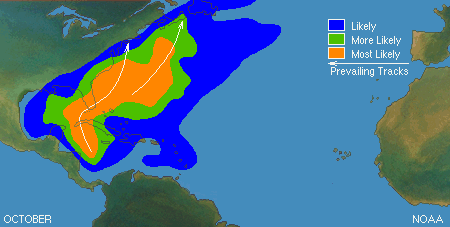
dalle origini al contatto con la costa USA, ha seguito con una precisione sconcertante la traccia delle traiettorie più probabili per questo genere di eventi.
Un record ce l'ha: è stata infatti la tempesta con il maggior diametro registrato da quando le misurazioni sono oggettive.
Ma nel 1938 (faceva caldo ma non c’era l'AGW), l'uragano di categoria 3 che colpì la costa del New England fece 600 vittime. Da allora è sicuramente migliorata la resilienza, ma sono anche clamorosamente aumentate le infrastrutture esposte al danneggiamento. Di qui, per fortuna, la diminuzione delle vittime e l’aumento dei danni.

Stormtrack – Sandy
Da
www.climatemonitor.it apprendo che:
nella storia sono state registrate circa
80 depressioni di questo genere che sono giunte ad interessare direttamente o indirettamente quel tratto della costa est degli USA.
Di queste,
20 sono state uragani, con tanto di nome e pedigree.

Stormtrack, probabilità per ottobre – Fonte NHC NOAA

Stormtrack – Eventi precedenti su New York
Ed ecco un po' di storia (per chi ha la memoria corta)
Before 1800
between 1278 and 1438 — A major hurricane struck the modern-day New York/New Jersey area, probably the strongest in recent millennium (dati riportati dalle popolazioni indigene).
August 25, 1635 — A hurricane that is reported to have tracked parallel to the East Coast impacts New England and New York, although it remains unknown if any damage occurs.
September 8, 1667 — A 'severe storm' is reported in Manhattan and is reported to be a continuation of a powerful hurricane which affected the Mid-Atlantic.
October 29, 1693 — The Great Storm of 1693 causes severe damage on Long Island, and is reported to create the Fire Island Cut as a result of the coast-changing storm surge and waves.
September 23, 1785 — Several large ships crash into Governors Island as a result of powerful waves which are reported to have been generated by a tropical cyclone.
August 19, 1788 — A hurricane strikes New York City or Long Island and is reported to have left the west side of the Battery "laid in ruins" after severe flooding occurs.
1800–99
Estimated track of the 1821 Norfolk and Long Island hurricane
October 9, 1804 — Heavy snow falls in Eastern New York peaking at 30 inches (75 cm) as a hurricane tracks northward along the East Coast and becomes extratropical, as cold air fed into the system.
September 5, 1815 — A hurricane tracks over North Carolina and parallels the East Coast before producing a heavy rainstorm in New York.
September 24, 1815 — Several hundred trees fall and the majority of the fruit was stripped off apple trees just prior to harvesting time after a hurricane makes landfall on Long Island.
September 16, 1816 — A possible hurricane strikes New York City, but damage remains unknown.
August 9, 1817 — A tropical storm produces heavy rainfall in New York City and Long Island.
September 3, 1821 — The 1821 Norfolk and Long Island hurricane results in severe damage on Long Island and is accompanied by storm surge of 13 feet (4 m). High wind causes a ship to crash on Long Island killing 17 people.
June 4, 1825 — A hurricane moves off the East Coast and tracks south of New York causing several ship wrecks, and killing seven people.
August 27, 1827 — High tides are reported in New York City which are caused by a hurricane offshore.
August 1, 1830 – A hurricane passes to the east of New York and produces gale-force winds to New York City and Long Island.
October 4, 1841 — Gale–force winds affect New York City as a hurricane tracks north along the East Coast of the United States. Damage is estimated at $2 million (1841 USD, $41 million 2007 USD).
October 13, 1846 — The Great Havana Hurricane of 1846 tracks inland, causing some damage to New York City.
October 6, 1849 — Severe structural damage occurs in New York City and Long Island with the passage of a hurricane to the east.
July 19, 1850 — A hurricane destroys a Coney Island bath house and causes heavy rain, although damage is unknown.[3] This storm destroyed the ship Elizabeth off Fire Island and drowned American transcendentalist Margaret Fuller.
August 24, 1850 — A storm that is reported to be a hurricane affects New York and New England although there is no known damage.
September 9, 1854 — A hurricane brushes the East Coast from Florida to New England causing rain on Long Island.
September 16, 1858 — Low barometric pressure of 28.87 mb at Sag Harbor is reported, and is thought to be associated with a tropical cyclone which causes no known damage.
September 6, 1869 — A
category 3 hurricane makes landfall in Rhode Island and brushes Long Island, which is affected by rain, although minimal damage resulted from the storm.
October 28, 1872 — A tropical storm passes over New York City and Long Island.
October 1, 1874 — New York City and the Hudson Valley receives rainfall after a minimal tropical storm tracked over Eastern New York.
September 19, 1876 — The remnants of the San Felipe hurricane track over western New York State, although damage is unknown.
October 24, 1878 — The state is affected by tropical storm-force winds and heavy rain with the passage of a hurricane, which made landfall in Virginia.
August 22, 1888 — A tropical storm tracks over New York City before tracking north along the East Coast of the United States.
August 24, 1893 — Hog Island is washed away by strong storm surge associated with a tropical storm of unknown strength. According to HURDAT, this was a
Category 1 hurricane that struck the western end of the Rockaway Peninsula, passing through Brooklyn as a weakening hurricane. Manhattan Island saw gale force winds to 56 mph.
October 10, 1894 10 People were killed and 15 injured at 74 Monroe Street in Manhattan when winds blew a building under construction onto a tenement crushing it. Extensive damage in the NYC and Long Island to telegraph lines, trees and boats docked on shore. Storm formed over Gulf of Mexico as a Category 3 weakened over land in the Southeast and re strengthened to a
Category 1 over the Chesapeake Bay before striking Long Island.
1900–49
Storm surge from the 1938 New England hurricane
September 17, 1903 — The 1903 Vagabond Hurricane produces wind gusts in excess of 65 mph (105 km/h) and 3 inches (75 mm) of rain in Central Park.
August 15, 1904 — A Category 2 hurricane skirts the East Coast of the United States producing gale-force winds and heavy rain in Eastern New York and Long Island.
August 2, 1908 — A hurricane develops near North Carolina and moves northward along the coast, brushing Long Island.
July 21, 1916 — Strong winds are reported on Long Island as a category 3 hurricane passes to the east.
August 25, 1933 — The 1933 Chesapeake Potomac Hurricane produces up to 6 inches (150 mm) of rain in Southeast New York State; other damage is unknown.
September 8, 1934 — A strong tropical storm makes landfall on Long Island.
September 20, 1936 — Strong waves and storm surge associated with a powerful hurricane floods much of Long Beach Island and causes severe beach erosion along the coast.
September 21, 1938 — The New England Hurricane of 1938 (Also Called "The Long Island Express") makes landfall on Suffolk County (Long Island) as a category 3 hurricane on the Saffir-Simpson hurricane scale.
Wind gusts of 125 mph (200 km/h) and storm surge of 18 feet (5 m) washes across part of the island.
In New York 60 deaths and hundreds of injuries were attributed to the storm. In addition, 2,600 boats and 8,900 houses are destroyed.[24] Throughout New England the hurricane killed over 682 people, damaged or destroyed over 57,000 homes, and caused property losses estimated at $4.7 billion (2005 US dollars).
September 14, 1944 — The 1944 Great Atlantic Hurricane makes landfall on Long Island as a category 1 hurricane on the Saffir-Simpson hurricane scale at a high forward speed of 40 mph (64 km/h). Wind gusts of well over 100 mph (160 km/h) breaks previous wind records in New York City, while a minimum pressure reading of 28.47 inches is recorded on Long Island. 117 homes are completely destroyed, while 2,427 are severely damaged and almost 1000 businesses are destroyed or damaged. In all, six people are killed, and one person is injured.
September 18, 1945 — A weak tropical depression crosses into Southeastern New York.
August 29, 1949 — A tropical storm tracks into Central New York causing no known damage.
1950–74
Rainfall from Hurricane Agnes (1972)
1954 — Hurricane Hazel - wind gust of 113 mph at Battery Park, highest ever recorded in New York City.
August 31, 1954 — Hurricane Carol makes landfall on Long Island and produces wind gusts of 120 miles per hour (190 km/h) on Montauk Point. On eastern Long Island near where Carol made landfall, a pressure of 960 mbar is recorded.[28] Winds on the island gust to 120 mph (195 km/h). The hurricane's storm surge covers the Montauk Highway in Montauk, effectively isolating eastern Long Island for a period of time. Due to the compact nature of the storm, most of Long Island is largely unaffected by the hurricane. Specific damage totals for New York are unknown, although the storm in its entirety causes $460 million (1954 USD) in damage.
September 10, 1954 — Hurricane Edna tracks to the east of Long Island producing 9 inches (230 mm) of rain. Prior to the storm, New York City orders an emergency standby for the majority of its hospitals, and subways.
August 13, 1955 — Hurricane Connie produces 13.24 inches (370 mm) of rain in Southeast New York, although damage is unknown.
September 28, 1956 — Hurricane Flossy tracks to the south of Long Island, brushing it with light rainfall.
October 1, 1959 — The remnants of Hurricane Gracie track into Central New York and drops up to 6 inches (150 mm) of rain.
September 11, 1960 — Hurricane Donna makes landfall on Long Island as a Category 2 hurricane. Sustained winds of 100 mph (160 km/h) on eastern Long Island and 70 mph (110 km/h) winds on western Long Island are reported, and tides are 6 feet (2 m) above normal along most of the coast. Strong waves also cause beach erosion and several homes along the shore to be destroyed. Due to well-executed warnings, damages are extremely low, and it is reported that no deaths result from the storm.
September 21, 1961 — Hurricane Esther causes $3 million (1961 USD, $20 million 2007 USD) in damage in Suffolk County as it tracks to the east of Long Island. Coastal areas of Long Island were flooded, as well as storm surge and wind gusts of 108 mph (173 km/h), which causes 260,000 homes to be left without power.
October 8, 1962 — Hurricane Daisy tracks east of New England, producing light rainfall in extreme eastern portions of Upstate New York.
September 23, 1964 — Beach erosion and moderate wind gusts are reported on Long Island as Hurricane Gladys tracks a couple hundred miles south of New York.
October 19, 1964 — Light rainfall is reported as Hurricane Isbell tracks off the coast.
September 10, 1969 — Rainfall up to 3 inches (75 mm) is reported on Long Island and in portions of Southeastern New York associated with Hurricane Gerda.
August 28, 1971 — Tropical Storm Doria produces up to 8 inches (200 mm) of rain in New York City and Upstate New York causing moderate to severe flooding and floods subways in New York City.
June 22, 1972 — Hurricane Agnes makes landfall near New York City and produces up to 12 inches (300 mm) of rain in Southeastern New York State and much of Western New York, with locally higher amounts. Storm tides of 3.1 feet (1 m) and wind gusts of 55 miles per hour (89 km/h) occur in New York City, and severe river flooding causes six deaths.
September 4, 1972 — Tropical Storm Carrie produces light rainfall on the eastern end of Long Island.
1975–99
August 11, 1976 — Hurricane Belle makes landfall on Long Island as a Category 1 hurricane on the Saffir-Simpson hurricane scale, producing up to 6 inches (150 mm) of rain. 30,000 people are evacuated in New York in anticipation of Belle. Wind gusts of up to 70 mph and tides of 7.2 feet (2.3 m) above normal are reported in New York City and Long Island. Moderate river flooding occurs, as well as minor crop damage. In all, one person is killed by a falling tree, and damage is reported at $257 million (1976 USD, $980 million 2007 USD).
September 1, 1978 — The remnants of Tropical Storm Debra produces light rainfall along the southern edge of New York State.
September 7, 1979 — The remnants of Hurricane David produce light to moderate rainfall up to 3 inches (75 mm) in much of New York State.
September 2, 1983 — Tropical Storm Dean produces light rain near New York City and causes minor beach erosion.
Late October, 1984 — The remnants of a tropical depression track just north of New York City, producing extremely light showers.
July 1985 — The remnants of Hurricane Bob produce light rainfall in Southeastern New York.
September 25, 1985 — The remnants of Tropical Storm Henri produce light rain in isolated areas.
Hurricane Gloria to the south of New York (1985)
September 27, 1985 — Hurricane Gloria makes landfall on Long Island as a Category 2 hurricane. Wind gusts of up to 100 mph (135 km/h) and 3.4 inches (86 mm) of rain contribute to $300 million (1985 USD, $591 million 2007 USD) in damage, and one fatality. In addition, 48 homes on Long Island were destroyed, and hundreds more were damaged.
September 10, 1987 — Tropical Depression Eleven produces rainfall up to 3 inches (75 mm) in much of New York State.
August 30, 1988 — Tropical Storm Chris produces moderate rainfall in Upstate New York.
September 24, 1989 — The remnants of Hurricane Hugo produce light rain and gusty winds in Central and Eastern New York.
August 28, 1991 — Hurricane Bob comes within a short distance of making landfall on the eastern tip of Long Island as a category 2 hurricane. Heavy rainfall up to 7 inches (175 mm) and high wind gusts causes two deaths and $75 million (1991 USD, $117 million 2007 USD), as well as severe beach erosion which came as a result of storm surge up to 6 feet (2 m) above average.
October 30, 1991 — The 1991 Perfect Storm kills one man when he is swept off a bridge, and causes moderate to severe beach erosion.
August 28, 1992 — The remnants of Hurricane Andrew produce light rainfall in the western portions of the state.
Hurricane Floyd produced heavy rain in New York (1999).
September 27, 1992 — Tropical Storm Danielle produces light rain in Western New York.
July 22, 1994 — Tropical Depression Two produces light rain in isolated areas of the state and generates thunderstorms which down several trees.
August 18, 1994 — Tropical Storm Beryl's remnants produce up to 3 inches (75 mm) of rain in Central New York causing moderate flooding which causes two fatalities and $1.5 million (1994 USD, $21 million 2007 USD) in damage, and 14 homes are damaged or destroyed. In addition, State Route 7 was closed for several hours due to flooding.
July 13, 1996 — Hurricane Bertha makes landfall on Long Island as a tropical storm, producing heavy rainfall which caused moderate flooding in the lower Hudson Valley in addition to tropical storm-force winds.
July 24, 1997 — Hurricane Danny causes light rainfall over New York City and Long Island.
September 8, 1999 — The remnants of Hurricane Dennis produce bands of heavy rain which caused some flooding, especially in Rockland County where three feet of flood water accumulated in some locations.
September 16, 1999 — Hurricane Floyd produces rainfall up to 13 inches (325 mm) and wind gusts of up to 60 mph (95 km/h) affect Southeastern New York. Severe flooding results from the storm, killing two people and causing an early estimate of $14.6 million (1997 USD, $18 million 2007 USD), although it is reported that damage could total to far more than that. One of the deaths occurred when a person was swept into a flooded river.
2000 and after
September 20, 2000 — The remnants of Hurricane Gordon produce light rainfall in Southeastern New York State.
June 17, 2001 — The remnants of Tropical Storm Allison produce moderate rainfall up to 3 inches (75 mm), although it fell in just a couple hours causing minor to moderate flash flooding.
August 10, 2002 — Tropical Storm Cristobal generates rip currents which drown three people on the coast of Long Island.
September 28, 2002 — The remnants of Hurricane Isidore produce widespread light rainfall over much of the state and moderate wind gusts. Some small trees are blown down, and minor power outages are reported.
September 21, 2003 — Hurricane Isabel affects the state with high winds and flooding. Damage in New York totals to $90 million (2003 USD, $98 million 2006 USD). In and around New York City, about 1.1 million customers were left without power, though most outages were fixed by the day after the hurricane passed through the region. Offshore of Long Beach, rough waves killed a man while bodysurfing.
August 4, 2004 — Hurricane Alex drops 2.83 inches (70 mm) of rain on Long Island.
August 13, 2004 — Tropical Storm Bonnie produces rainfall peaking at 4 inches causing several rivers to swell to at or slightly above flood stage.
August 14, 2004 — Hurricane Charley brushes Long Island and produces light rainfall.
September 4, 2004 — Hurricane Gaston produces light rainfall on Long Island.
September 9, 2004 — The remnants of Hurricane Frances produces heavy rainfall up to 7 inches (175 mm) which causes extensive flooding in central New York. One death, a drowning, and $6 million (2005 USD, $6.5 million 2007 USD) in damage results from the flooding.
July 9, 2005 — The remnants of Hurricane Cindy produce moderate rainfall in Upstate New York causing light damage due to flooding and gusty winds, which downed some trees.
August 30, 2005 — The remnants of Hurricane Katrina produce heavy rainfall up to 5 inches (125 mm) of rain in the western portion of the state. High winds also affect the state, with 4,500 people in Buffalo left without power after high winds downed trees and power lines.
October 5, 2005 — Tropical Storm Tammy's remnants contribute to a rainstorm which turns into the Northeast U.S. flooding of October 2005. Up to 13 inches (325 mm) of rain cause severe flooding throughout the Hudson Valley, killing 10 and causing millions of dollars in damage.
September 2, 2006 — The remnants of Hurricane Ernesto produce light to moderate rainfall over much of the state and wind gusts of up to 60 miles per hour (97 km/h). Numerous trees and powerlines are reported fallen, and several thousand people are left without power, primarily in the New York City area.
June 5, 2007 — Tropical Storm Barry produces 3.91 inches (99 mm) of rain in New York City. The heavy rainfall leads to flooding in the Finger Lakes region of New York State, washing out roads and driveways. Roads and several driveways were washed out.
September 6, 2008 — Hurricane Hanna strikes Long Island with gusts of winds of 52 mph (84 km/h) at Shinnecock Inlet. Aside from numerous downed trees, damage is minimal.
August 22, 2009 — Offshore Hurricane Bill causes severe beach erosion and coastal damage on the southern shore of Long Island.
August 27–28, 2011 — Hurricane Irene makes landfall on Coney Island as a Category 1 hurricane and immediately weakens to a tropical storm shortly thereafter. Storm surge reaches underneath the boardwalks in both Coney Island and Long Beach. The Hudson River flooded, inundating parts of lower Manhattan. Top recorded winds reach 70 mph at the height of the storm and causes parts of New York City and Metropolitan areas to evacuate; the city shuts down including MTA, and mass transit. Wind gusts topped 91 mph (146 km/h) in Sayville, NY. There were 2 EF0 tornadoes that were confirmed by the National Weather Service, although the damage caused by these tornadoes were minimal. Also Irene caused many power outages and trees down. It was reported that LIPA The Long Island Power Authority had over 400,000 power outages. The storm killed five people in the state. The storm also had major impact on Upstate NY, including the Capital District Region. Severe flooding was widespread, with the Mohawk River rising 3.2 feet above flood stage in Schenectady, NY's historical Stockade district. Schenectady County Community College was severely flooded, causing upwards of $1 million in damage. Parts of Greene, Schoharie, and Delaware Counties were nearly unreachable. This storm was also historic in another way, in that it caused the National Weather Service in Albany, NY to issue a Tropical Storm Warning for the local forecast area. This had never been done before, and actually required a breach in protocol to achieve. Prior to this event, the Albany, NY forecast area was considered outside of the valid area for Tropical Storm warnings.
October 28-29, 2012- Hurricane Sandy takes an extremely rare track, making landfall near Atlantic City, New Jersey with 85 m.p.h. winds. Sandy causes an all-time high storm surge in New York City along with widespread power outages and an unprecedented, system-wide disruption of mass transit service.
Fonte:
http://en.wikipedia.org/wiki/List_of_New_York_hurricanes